0%
Loading ...

IPRG RESEARCH PUBLICATION

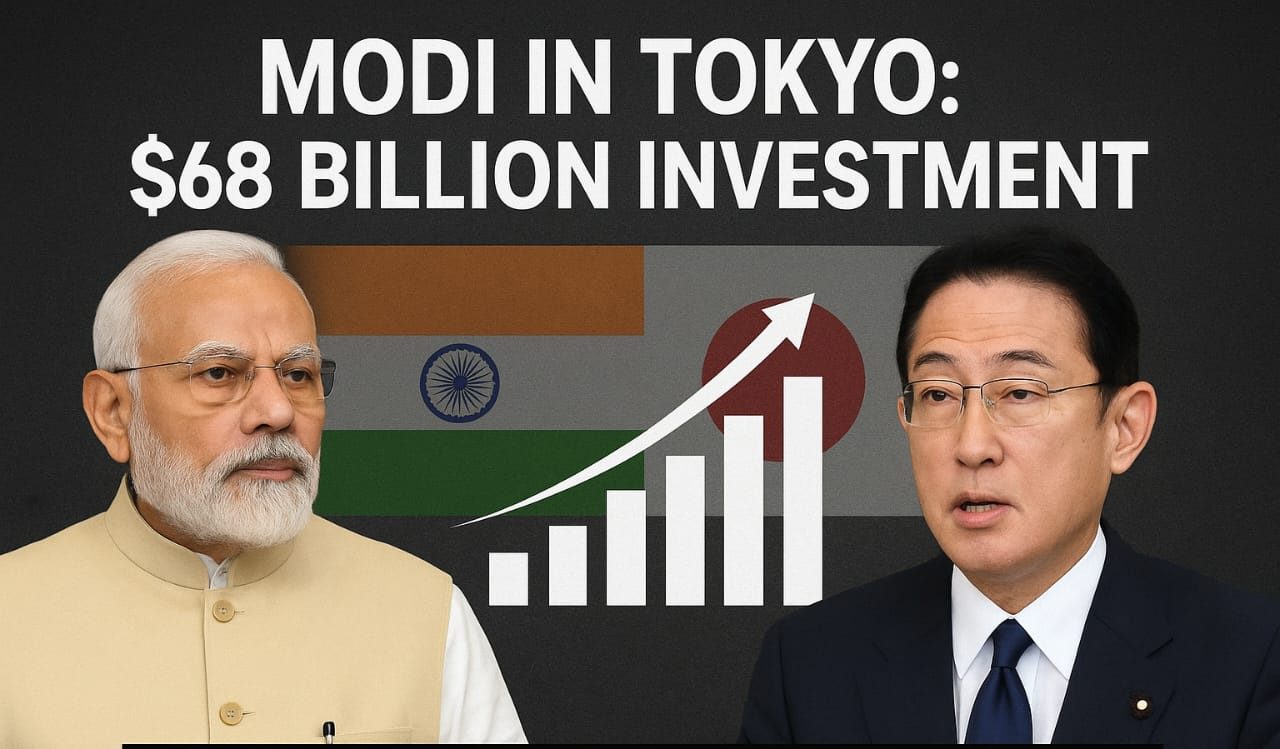
Modi in Tokyo: A Decade Blueprint—Investment, Economic Security, and Indo-Pacific Strategy

India and Japan reset the pace of their “Special Strategic & Global Partnership” with a concrete 10-year vision: deeper supply-chain security, defence interoperability, high-speed rail, semiconductors, critical minerals, and talent mobility—anchored by a private-sector investment push of nearly ¥10 trillion (~$68 billion).

1) What exactly was agreed? The “Next Decade” frame

India and Japan released a Joint Vision for the Next Decade and a Joint Statement, mapping out cooperation in economy, security, technology, and people-to-people ties.

The headline outcome: Japan aims to invest ¥10 trillion in India over the next decade, especially in manufacturing, digital transformation, green energy, and advanced technologies.

2) The Economic Security Initiative: the 5 priority lanes

The two nations launched a new Economic Security Initiative to boost resilience and reduce dependency on single markets. The five focus areas are:

Semiconductors

Critical Minerals

Artificial Intelligence & Advanced Technology

Industrial Innovation & Advanced Manufacturing

Supply-Chain Resilience

3) Defence & Security: operationalizing the Indo-Pacific

Both sides reaffirmed their commitment to a free and open Indo-Pacific, strengthening defence ties through co-development of technology, military exercises, and maritime cooperation.

Cybersecurity and defence-industrial cooperation are set to intensify, reflecting shared concerns over rising regional tensions.

4) High-speed rail & infrastructure: Shinkansen momentum

The Mumbai–Ahmedabad bullet train project remains a flagship, with renewed emphasis on timelines.

Complementary projects in industrial corridors and smart urban transit also gained traction, reinforcing India’s “Make in India” vision.

5) Talent & Mobility: a scale jump

Japan and India agreed to facilitate the movement of around 500,000 workers and students over the next five years.

This not only addresses Japan’s labour shortages but also enhances India’s human capital by building global skills pipelines.

6) Trade winds & macro context: hedging turbulence

The visit comes at a time when global trade faces uncertainty from tariffs, supply-chain shocks, and geopolitical disruptions.

India–Japan ties aim to provide businesses with predictability through rules-based, long-term cooperation.

7) Outcomes at a glance

¥10 trillion investment over 10 years

Economic Security Initiative in 5 sectors

Defence cooperation under Indo-Pacific framework

Bullet train & industrial corridors push

500,000 worker/student mobility plan

8) What to watch next

Announcements of semiconductor and critical minerals projects

Bullet train procurement and financing updates

Defence co-production agreements and joint R&D calls

Skilling programs for workers moving to Japan

9) Strategic take: Why this visit is different

Unlike past bilateral summits that focused on declarations, this one sets a numeric investment target, specific technology sectors, and a 10-year roadmap. Japan brings capital and high technology; India contributes scale, demand, and talent. If implemented well, this partnership could anchor India’s industrial and strategic rise in the Indo-Pacific for the next decade.

Editorial Note

This visit reflects a shift from symbolism to execution. The ¥10 trillion pledge is less about short-term cheques and more about long-term confidence in India’s growth story. The true test lies in delivery—speeding up clearances, building chip and mineral ecosystems, and training half a million workers. If India and Japan can deliver on these promises, this partnership will become a model for friend-shored growth and industrial resilience.

Reader Corners

Which sector do you think will benefit first—Semiconductors, Critical Minerals, High-speed Rail, or Defence?

Should India prioritize Japanese investment in infrastructure or advanced technology?

Do you believe the target of 500,000 workers moving to Japan in 5 years is realistic?

Can this partnership truly balance China’s influence in the Indo-Pacific?

Related Publications

Gendered Human Capital Misallocation in India: Education, Labour Market Barriers, and Policy Failure

Authors: Simran Sinha; Beaulah Anton; Priyansi; Rezaa Sharma

Abstract:

India has made significant progress in expanding female education, yet women’s labour market outcomes remain disproportionately poor. This study reframes this paradox as an issue of gendered human capital misallocation, rather than a deficit in skill formation. It examines how the gendered labour market constraints impede the educated women from productive employment, leading to underutilisation of skills and decreased economic efficiency.

Utilising a qualitative-descriptive approach and secondary data from multiple databases, this paper examines unemployment, occupational segregation, unpaid care work, and wage disparities between educated women and their male counterparts. The findings show a persistent education-employment paradox: increased female education correlates with high unemployment, informalisation, and labour force withdrawal. These patterns are driven by demand-side discrimination, inflexible work arrangements, safety and challenges in mobility, and unequal distribution of care responsibilities. The analysis argues that government policies have largely prioritised educational expansion without addressing labour market absorption, therefore sustaining gendered inefficiencies. Addressing this inefficient allocation is what makes it important for optimal human capital utilisation and for inclusive economic growth.

Keywords:
Human Capital, Female labour, Labour market segmentation, Gender wage gap, public policy, employment, Human capital misallocation

Read More »
Systematic Review of Government-Led Education Reforms in India: Policy, Implementation and Outcome.

Authors : Darpan Kumari ,Varshita Saxena, Sayf Ali

Abstract :

In this paper, government-led education reforms in India were reviewed while focusing on policy design, legal foundations, implementation, and outcomes. It examines landmark reforms, including the Sarva Shiksha Abhiyan (SSA, 2001), the Right of Children to Free and Compulsory Education Act (RTE Act, 2009), the National Education Policy (NEP 2020), and other education schemes such as the Mid-Day Meal Scheme (MDMS). The study situates these reforms within India’s constitutional framework, particularly Article 21A of the Constitution, and evaluates the persistent gap between policy design and implementation. A comparative analysis with Nigeria’s education policies and laws, particularly the Universal Basic Education (UBE) Act of 2004 and the National Policy on Education (NPE), reveals both parallels and differences in how two developing nations have pursued universal access to quality education. The paper finds that while India has achieved commendable progress in enrolment and school infrastructure, learning outcomes, equity, and implementation remain deficient. The policy implementation gap, caused by financial constraints, bureaucratic issues, and inadequate implementation plans and execution, continues to undermine reform potential. The paper concludes with lessons for public policy design and reform implementation applicable to India, Nigeria, and comparable developing-country contexts.

Keywords :
Education reform, India National Education Policy, Right to Education, Access vs Quality Divide, Policy to implementation gap, Comparative Education, State Capacity, Federalism

Read More »
Shaping of Perceptions & Misperceptions Among Masses During War Escalations : A Comparative Analysis of Information Dynamics, Media Influence, and Perception Management

Authors : Hridoy Pran Sarma , Ashi Agrawal

Abstract :

In the modern-day world, war is not only about fighting on the battlefield but also
manipulating the belief of the opponent country using intelligence. During war escalation, people form opinions based not on their personal experience, but from news stories and government releases, along with other posts on social media. As a result, they become more susceptible to misperceptions; these are misconstrued situations employed to frighten, sow discord and garner the unthinking support of the public for the providing of military firepower. Due to an increase in the use of social media and modern means of communication, this task has become even easier as not everyone is well-equipped to measure what is happening during wars. Misconceived observations of the conflict can aggravate and harm the process of resolution. The paper seeks to ascertain the role of the government and media in distorting the public opinion during wars by analysing case studies such as Russia – Ukraine War and other major wars worldwide. Usage of management perceptions, misinformation, and the war in which does escalate.

Keywords:
  Perception Management, Misinformation, War Escalation, Public Opinion, Media Literacy, Information Warfare.

Read More »
Gender Neutrality In Law , State & Society

Abstract

An interdisciplinary approach is attempted in this paper to analyse the interplay between gender neutrality and
access to justice. While gender neutrality is often said to be a very progressive idea in law, a host of new problems
are generated when it is applied in a postcolonial society like India. The paper draws from the disciplines such
as law, political science, international relations, history, and statistics to criticize the assumption that neutrality
would bring forth justice all by itself.
Legal analyses show that gender-neutral laws may in fact sometimes uphold patriarchal structures when no steps
are taken to address the underlying inequalities. The political approach ponders over the questions of how
governance, policy language, and representation impact the availability of justice for gender-diverse individuals.
From a data standpoint, it illustrates how binary data catapult non-binary identities into the margins. From a
historical and international perspective, the modern laws are seated within colonial legacies and critique the
global human rights discourse for its limited inclusiveness.
We argue that gender neutrality, though important, remains alone insufficient. A meaningful framework of access
to justice must be context-sensitive, historically aware, and structurally inclusive of all gender identities.

Keywords: Gender Neutrality, Access to Justice, Constitutional Law, Gender-Based Violence, Public Policy,
Legal Reform, Colonial Legacy, International Norms, Gender Data, Inclusive Governance

Read More »
Trending but Not Transforming: Generation Z’s Social Media Activism and Its Diplomatic Impact in International Relations

Authors : Gayatri Gaikwad , Mehak Bhutani , Amina Dossa, Shalini Sarkar, Zainab Amjad

Abstract :


Generation Z the cohort born between approximately 1997 and 2012 has emerged as the most digitally mobilised generation in political history, leveraging platforms such as TikTok, Instagram, X and Discord to organise transnational advocacy and challenge entrenched governance structures. Yet a critical paradox persists ,the generation that trends globally rarely transforms diplomatically. This paper examines the relationship between Generation Z’s social media activism and its tangible impact on international relations, arguing that while digital activism has democratised political expression and produced measurable domestic disruptions, its structural conversion into lasting diplomatic outcomes remains limited and uneven. Drawing on comparative case studies alongside empirical evidence from quantitative platform studies and theoretical frameworks of soft power, generational theory, and networked social movements, this paper identifies the conditions under which digital youth activism does and does not translate into diplomatic recalibration. It further interrogates platform architecture, disinformation dynamics, and the mobilisation-distraction paradox as structural constraints on Gen Z’s diplomatic agency. The findings suggest that while Generation Z constitutes a genuinely novel geopolitical force, the efficacy of their digital activism in reshaping international relations depends critically on context, institutional responsiveness, and the capacity to bridge online momentum with sustained offline institutional engagement.

Keywords –
Gen z, Diplomacy , Social Media ,Digitalisation

Read More »
OUTPUT VS OUTCOME ANALYSIS OFPMAY G & POSHAN ABHIYAAN SCHEMES

Authors : Pushpa Akshaya Miriyala , Armaan Sareen , Shravani Tharanath

Abstract :

India’s flagship welfare schemes – Pradhan Mantri Awaas Yojana-Gramin (PMAY-G) and POSHAN Abhiyaan, represent landmark commitments to rural housing provisioning and nutritional security respectively. Yet persistent gap separates the administrative growth outputs with substantive development outcomes. This paper undertakes a qualitative output-versus- outcome analysis of both schemes, interrogating structural gaps between quantitative delivery metrics – houses sanctioned, anganwadi coverage, beneficiaries enrolled and lived realities of human capability enhancement. The study critically examines how implementation accuracy, convergence deficits, workforce vacancies, community level absorption mediate the translation of output impact to welfare impact. Data from NFHS-4&5 trends, CAG audit observations, POSHAN tracker data bring a systemic mark: output saturation co-existing with outcome stagnation. The paper argues for realigned evaluation that centres nutritional security and housing quality as primary indices of scheme effectiveness over mere physical completion rates.

KEYWORDS :

Maternal Morbidity, Open Defecation (ODF), Aspirational Districts, Anganwadi Health Workers (AHW), Take Home Rations, Growth Monitoring Promotion Sessions.

Read More »
error: Content is protected !!
Scroll to Top