0%
Loading ...

IPRG RESEARCH PUBLICATION

Latest
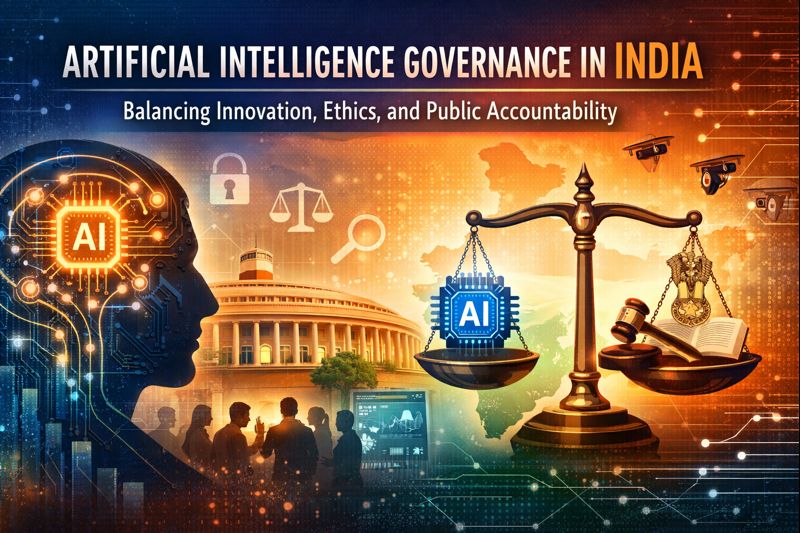
Artificial Intelligence Governance in India: Balancing Innovation, Ethics, and Public Accountability

Introduction: AI and the New Governance Paradigm

Artificial Intelligence (AI) has emerged as one of the most transformative technologies of the 21st century, reshaping governance, public service delivery, economic growth, and national security worldwide. In India, the rapid integration of AI across sectors such as healthcare, education, finance, policing, and welfare administration signals a decisive shift towards data-driven governance. However, as AI systems increasingly influence public decision-making, the need for a robust governance framework becomes both urgent and unavoidable.

India’s Policy Approach: Innovation First

India’s AI governance strategy has largely prioritised innovation and capacity-building over regulation. Policy initiatives led by NITI Aayog have promoted the vision of “AI for All,” focusing on leveraging technology for social inclusion and developmental outcomes. By emphasising sectors such as agriculture, healthcare, education, and smart cities, India has positioned AI as a tool for public good rather than mere commercial advancement. However, this innovation-first approach has also exposed regulatory gaps, particularly in areas related to ethics, accountability, and citizens’ rights.

Data Privacy and the Surveillance Question

One of the most critical challenges in AI governance is the issue of data privacy. AI systems depend on vast datasets, often sourced from government platforms and digital public infrastructure. While data-driven governance enhances efficiency and targeting, it also raises serious concerns about mass surveillance and misuse of personal information. In the absence of a comprehensive AI-specific legal framework, citizens remain vulnerable to opaque data practices that may undermine the constitutional right to privacy.

Algorithmic Bias and Social Inequality

AI systems are only as neutral as the data they are trained on. In India’s deeply stratified social structure, biased datasets can lead to discriminatory outcomes when AI is deployed in welfare delivery, predictive policing, or automated decision-making. Instead of correcting systemic inequalities, poorly governed AI risks reinforcing caste, gender, and economic disparities, thereby contradicting the principles of equality and social justice enshrined in the Constitution.

Transparency and Accountability in Automated Decision-Making

A major governance concern surrounding AI is the lack of transparency in algorithmic decision-making. Many AI systems function as “black boxes,” making it difficult to explain or audit their outcomes. When such systems are used in public administration, this opacity weakens accountability and limits citizens’ ability to seek redressal. Democratic governance requires that decisions affecting citizens’ lives remain explainable, reviewable, and contestable.

Learning from Global AI Governance Models

Globally, governments are moving towards structured and risk-based AI regulation. The European Union’s AI Act, for instance, categorises AI applications based on their potential harm and imposes obligations accordingly. India, while observing these developments, must evolve a governance framework tailored to its socio-economic realities. Blindly importing global models without contextual adaptation may prove ineffective in addressing India’s unique governance challenges.

The Way Forward: Ethical, Inclusive, and Accountable AI

India’s future AI governance framework must rest on three pillars: ethical design, regulatory accountability, and inclusive policymaking. Ethical principles such as fairness, transparency, and human oversight should be embedded at the design stage of AI systems. Independent regulatory mechanisms must be empowered to conduct algorithmic audits and enforce compliance. Most importantly, AI policymaking should be participatory, involving civil society, academia, technologists, and marginalised communities.

Conclusion: Governing Technology for Public Good

Artificial Intelligence holds immense potential to strengthen governance and accelerate India’s developmental aspirations. Yet, without adequate safeguards, it can also threaten democratic values, civil liberties, and social equity. The task before Indian policymakers is to ensure that AI remains a tool for empowerment rather than control. A balanced, citizen-centric AI governance framework will be essential in ensuring that technological progress aligns with constitutional morality and public accountability. For institutions like IPRG, engaging with AI governance is not just timely—it is necessary for shaping India’s digital future responsibly.

Leave a Comment

Your email address will not be published. Required fields are marked *

Related Publications

The Role of Climate Finance in Early Warning Systems for Rural and Coastal Populations: A Comparative Analysis of India, Rwanda, and Trinidad and Tobago

Authors : Ruel Fordyce, Shivangi Gedam, Ashutosh Sarkar

Abstract :

Climate change has intensified the frequency and severity of extreme weather events, disproportionately affecting rural and coastal populations in developing countries. Early Warning Systems (EWS) have emerged as critical tools for reducing disaster risks; however, their effectiveness is closely tied to the availability and allocation of climate finance. This paper examines the role of climate finance in strengthening EWS, with a primary focus on India and comparative insights from Trinidad and Tobago and Rwanda. Using a qualitative research approach based on secondary data, the study explores how financial mechanisms such as the Green Climate Fund and Systematic Observations Financing Facility support EWS development. Findings indicate that while India has made significant progress in integrating EWS into national disaster management frameworks, gaps remain in financing distribution, local capacity, and last-mile communication. Rwanda demonstrates effective utilization of targeted climate finance for infrastructure upgrades, while Trinidad and Tobago highlights challenges which are typical of Small Island Developing States, including funding gaps and institutional fragmentation. The study concludes that sustained, equitable, and locally targeted climate finance is essential for enhancing resilience and protecting vulnerable populations.

Keywords

Climate finance; Early warning systems; India; Rwanda; Trinidad and Tobago; Rural
vulnerability; Coastal resilience; Disaster risk reduction

Read More »
Gendered Human Capital Misallocation in India: Education, Labour Market Barriers, and Policy Failure

Authors: Simran Sinha; Beaulah Anton; Priyansi; Rezaa Sharma

Abstract:

India has made significant progress in expanding female education, yet women’s labour market outcomes remain disproportionately poor. This study reframes this paradox as an issue of gendered human capital misallocation, rather than a deficit in skill formation. It examines how the gendered labour market constraints impede the educated women from productive employment, leading to underutilisation of skills and decreased economic efficiency.

Utilising a qualitative-descriptive approach and secondary data from multiple databases, this paper examines unemployment, occupational segregation, unpaid care work, and wage disparities between educated women and their male counterparts. The findings show a persistent education-employment paradox: increased female education correlates with high unemployment, informalisation, and labour force withdrawal. These patterns are driven by demand-side discrimination, inflexible work arrangements, safety and challenges in mobility, and unequal distribution of care responsibilities. The analysis argues that government policies have largely prioritised educational expansion without addressing labour market absorption, therefore sustaining gendered inefficiencies. Addressing this inefficient allocation is what makes it important for optimal human capital utilisation and for inclusive economic growth.

Keywords:
Human Capital, Female labour, Labour market segmentation, Gender wage gap, public policy, employment, Human capital misallocation

Read More »
The Role Of Climate Forecasts In Shaping Adaptation Behaviour: Evidence From A Cross-Country Survey

Authors : Fareed Ahmad, Mwita Chacha, Obodo Lotachi

Abstract

Climate change presents considerable global threats, particularly in regions that are dependent on climate-sensitive livelihoods. While advances in climate forecasting have improved the availability and accuracy of climate information, a persistent gap remains between information access and actual adaptive behaviour. This study investigates the
behavioural mechanisms that translate climate forecasts into adaptive action using a cross-country survey of 309 respondents across six countries: India, Kenya, Egypt,
Indonesia, Nigeria and Japan. Using quantitative method including descriptive statistics, Spearman’s correlation and multiple linear regression, this study examined the roles of Access to Climate Forecast Information (ACF), Trust in Climate Information (TCI) and Climate Risk Perception (CRP) in shaping Climate Adaptation Behaviour (CAB).
Descriptive analysis revealed a pronounced perception-action gap: climate risk
perception was high (mean = 4.09) while adaptation behaviour remained moderate
(mean = 3.53). Regression analysis demonstrated that trust in climate information (β =0.299, p < 0.001) and access to forecasts (β = 0.179, p = 0.003) were significant predictors of adaptive behaviour, whereas risk perception alone was not statistically significant (p = 0.275). These findings carry important implications for designing climate services and evidence-based policy interventions. Keywords:
Climate Adaptation Behaviour; Climate Forecasts; Trust in Information; Risk
Perception; Cross-Country Analysis; Climate Policy

Read More »
Diaspora Kitchens and Diplomacy: Indian Restaurants as Informal Soft Power Sites Abroad

Authors: Prapti Das; Diya Jain; Aditi Shree

ABSTRACT

Indian diaspora restaurants increasingly serve as unrecognised informal venues of cultural diplomacy, mediating the world’s perceptions of India at the level of daily culinary practice. The existing literature has viewed these sites mostly through perspectives on soft power, identity formation, and cultural representation in terms of the symbolic and affective impacts they exert within host societies. Drawing from international relations, food studies, and diaspora scholarship, this paper places overseas Indian restaurants as decentralised informal soft power actors outside of any framework controlled by the state. While their cultural and representative roles have been copiously documented otherwise; it is rather inadequately theorised and even more poorly empirically demonstrated how economic dimensions underlie their diplomatic salience. This paper highlights the fact that there has been no systematic analysis of the economic impact of diaspora restaurants. It puts forth the argument that while discussing culinary soft power and attempting to foreground, or bring into consideration, the material conditions that sustain it, one must regard economic viability not as incidental but rather as integral to the endurance and reach of informal diplomacy. This paper is another addition to the debate around soft power in its call for bringing cultural influence back into an integrated political economy approach with economic structures as a way of providing a fuller account of how diaspora kitchens participate in global diplomatic processes.

KEYWORDS

Gastrodiplomacy, Indian Diaspora, Soft Power, Informal Diplomacy, Culinary Political Economy, Diaspora Restaurants, Cultural Diplomacy, Everyday Diplomacy

Read More »
Systematic Review of Government-Led Education Reforms in India: Policy, Implementation and Outcome.

Authors : Darpan Kumari ,Varshita Saxena, Sayf Ali

Abstract :

In this paper, government-led education reforms in India were reviewed while focusing on policy design, legal foundations, implementation, and outcomes. It examines landmark reforms, including the Sarva Shiksha Abhiyan (SSA, 2001), the Right of Children to Free and Compulsory Education Act (RTE Act, 2009), the National Education Policy (NEP 2020), and other education schemes such as the Mid-Day Meal Scheme (MDMS). The study situates these reforms within India’s constitutional framework, particularly Article 21A of the Constitution, and evaluates the persistent gap between policy design and implementation. A comparative analysis with Nigeria’s education policies and laws, particularly the Universal Basic Education (UBE) Act of 2004 and the National Policy on Education (NPE), reveals both parallels and differences in how two developing nations have pursued universal access to quality education. The paper finds that while India has achieved commendable progress in enrolment and school infrastructure, learning outcomes, equity, and implementation remain deficient. The policy implementation gap, caused by financial constraints, bureaucratic issues, and inadequate implementation plans and execution, continues to undermine reform potential. The paper concludes with lessons for public policy design and reform implementation applicable to India, Nigeria, and comparable developing-country contexts.

Keywords :
Education reform, India National Education Policy, Right to Education, Access vs Quality Divide, Policy to implementation gap, Comparative Education, State Capacity, Federalism

Read More »
Trending but Not Transforming: Generation Z’s Social Media Activism and Its Diplomatic Impact in International Relations

Authors : Gayatri Gaikwad , Mehak Bhutani , Amina Dossa, Shalini Sarkar, Zainab Amjad

Abstract :


Generation Z the cohort born between approximately 1997 and 2012 has emerged as the most digitally mobilised generation in political history, leveraging platforms such as TikTok, Instagram, X and Discord to organise transnational advocacy and challenge entrenched governance structures. Yet a critical paradox persists ,the generation that trends globally rarely transforms diplomatically. This paper examines the relationship between Generation Z’s social media activism and its tangible impact on international relations, arguing that while digital activism has democratised political expression and produced measurable domestic disruptions, its structural conversion into lasting diplomatic outcomes remains limited and uneven. Drawing on comparative case studies alongside empirical evidence from quantitative platform studies and theoretical frameworks of soft power, generational theory, and networked social movements, this paper identifies the conditions under which digital youth activism does and does not translate into diplomatic recalibration. It further interrogates platform architecture, disinformation dynamics, and the mobilisation-distraction paradox as structural constraints on Gen Z’s diplomatic agency. The findings suggest that while Generation Z constitutes a genuinely novel geopolitical force, the efficacy of their digital activism in reshaping international relations depends critically on context, institutional responsiveness, and the capacity to bridge online momentum with sustained offline institutional engagement.

Keywords –
Gen z, Diplomacy , Social Media ,Digitalisation

Read More »
error: Content is protected !!
Scroll to Top